Jackson Pollock was in his thirties when Peggy Guggenheim offered him his first solo show in 1943 at her Art of This Century gallery in New York. The automatism advocated by surrealism, notably by André Masson, then in exile in New York, acted as a stimulant on Pollock's painting. Although best known for his "drip paintings," which made him the most iconic painter of American abstract expressionism, Pollock always heavily relied on drawing, both in his figurative work in the 1930s and in his symbolic language of the 1940s, as well as in his abstract expressionism of the 1950s.
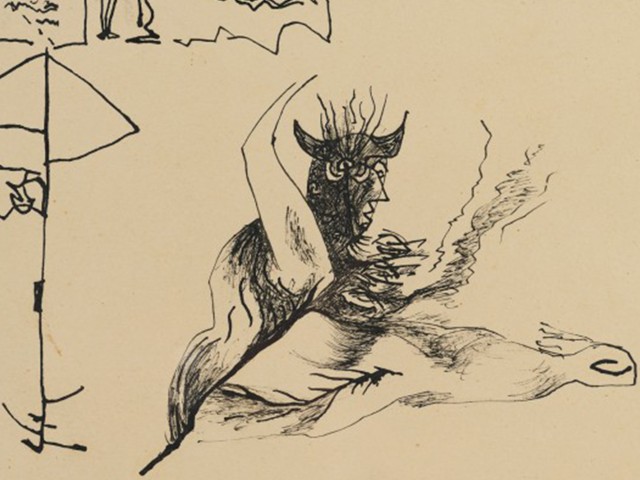
It was difficult for New York artists to escape the pervasive influence of surrealism. In March 1942, the Pierre Matisse Gallery exhibited the Artists in Exile, bringing together Matta, Tanguy, Seligmann, and Ernst. That same year, the Curt Valentine Gallery showcased recent paintings by Matta and Masson, who also exhibited his drawings from 1938 to 1942 at the Marian Willard Gallery. The figure of the Minotaur, which Pollock repeatedly incorporated into his work, illustrates Picasso's influence on his art. References to the master are abundant in his work until the late 1940s. According to William Rubin, in an article published in 1967 in Art in America, the appearance of the Minotaur, along with other iconographic references specific to Picasso's work, in Pollock's art signifies an Oedipal complex towards his Catalan predecessor. The theme of the Minotaur is also evoked in "Pasiphaë," a large colorful composition (Pasiphaë, Jackson Pollock, 1943, oil on canvas, Metropolitan Museum of Art, New York) created at the same time as our drawing (lot 43). Pasiphaë is the name of the Cretan princess who gives birth to the half-man, half-bull figure, a legendary figure to which many artists refer to explore themes of war, suffering, and death. This work is part of a significant series of drawings that was exhibited in 1980 at the MoMA in New York, during the Jackson Pollock, Drawing Into Painting exhibition, and whose sheet titled "War" from 1947 is now part of the Met's collection. This series of drawings foreshadows a creative turning point that would establish Pollock as one of the leaders of abstract expressionism.
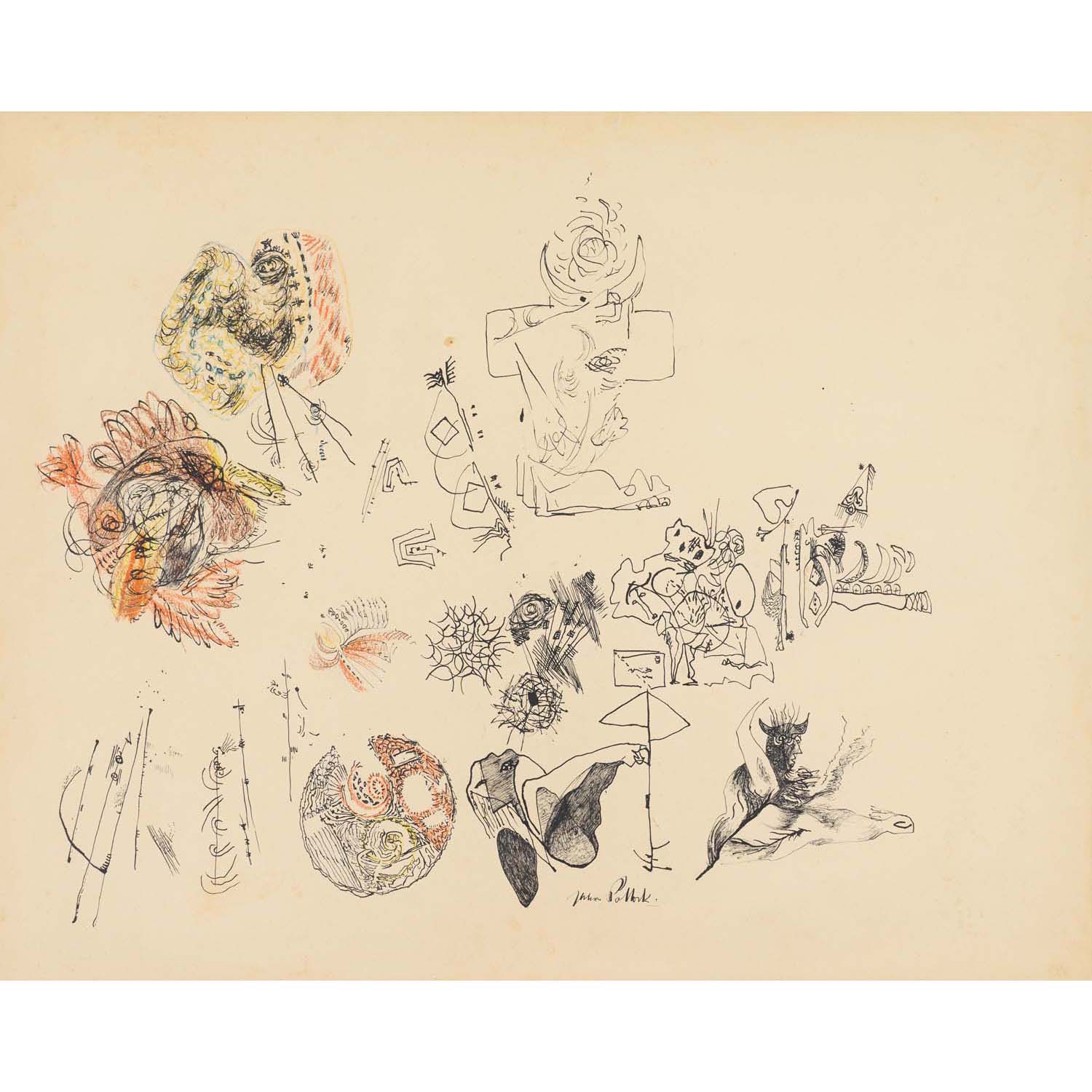
Alfonso Ossorio y Yangco met Pollock during his second exhibition at the Parsons Gallery in 1949, when both were closely associated with the surrealist movement. An intense friendship ensued, leading to a rich correspondence. Pollock spent the winter and spring of 1950 at Ossorio's in New York. The following year, on the advice of his friend, Ossorio purchased a large property in East Hampton, "Creeks," where he spent the rest of his life collecting Pollock's works. This drawing was gifted by the artist to Ossorio in the year of their meeting.
"I’m very representational some of the time, and a little all of the time. But when you’re painting out of your unconscious. figures are bound to emerge.’’
Jackson Pollock