For the first session of the year devoted to publishing, PIASA has the privilege of offering for sale a selection of engravings by some of the most emblematic artists of the second half of the 20th century. From the key figures of modern art such as Pablo Picasso or Salvador Dali to contemporary art scenes, the sale on Thursday 12 March 2020 testifies to the quality and dynamism of this department.
The fields that his family cultivated were the setting for his first artistic experiences. Barely 16 years old, the Japanese visual artist Yayoi Kusama won the competition of the Zen-Shinshû Regional Arts Exhibition. She left Matsumoto, her hometown, and continued her studies at the Hiyoshigaoka High School in Kyoto where she became familiar with traditional and modern Japanese painting. The anti-machist and provocative content of her works can be explained by the particularly patriarchal environment in which she evolves.
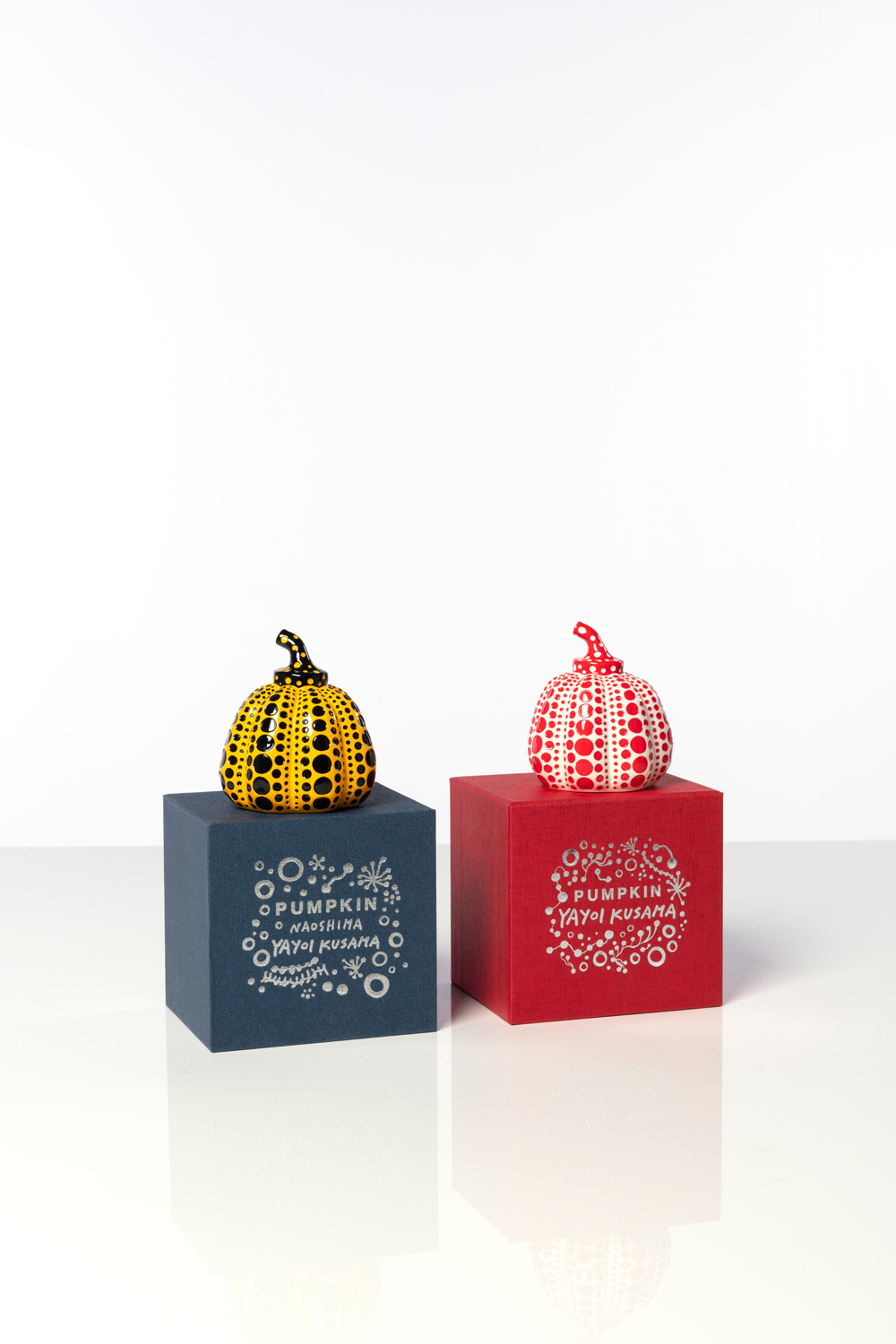
Yayoi Kusama (born 1920) Pumpkin, Yellow, Naoshima
Estimation : 600 / 800 €
The rigidity of the shackles imposed on her by her school decided the artist to turn to Western art. Despite the success of several exhibitions in the early 1950s, first in Matsumoto and then in Tokyo, Yayoi Kusama left for the United States in 1957 and settled in New York a year later. The presentation of his "Infinity Nets" series at the Brata Gallery in 1959 was an important step. Converting his neuroses into a source of inspiration, his approach can easily be compared to art therapy. These abstract works covered with countless brushstrokes are strongly influenced by the hallucinatory visions she experienced as a child. Like so many psychedelic motifs, spots and dots are omnipresent.
In contact with the New York art scene (Jasper Johns, Yves Klein, Piero Manzoni, Claes Oldenburg and Andy Warhol), she befriended Donald Judd, who became her studio neighbour from 1961 onwards. During this period she created a large number of sculptures and accumulations.
Gravitating around the notion of self-representation, Yayoi Kusama quite naturally experimented with happening and performance, as in 1966 with "14th Street Happening" during which the artist lay on a mattress covered with protruding phallic forms, also decorated with dots.
Some thirty years after having been invited but not invited, the artist represented Japan at the 1993 Venice Biennale. At the beginning of the 1970s, she returned for good to the country where she was born before being admitted to the Seiwa psychiatric hospital.
Over the years, the pumpkin has become a veritable leitmotif in her iconographic vocabulary. Endowed with charming and seductive shapes, this vegetable plays the role of a self-portrait.
Among the pieces on sale, the set of 5 pumpkin sculptures in Limoges porcelain was created in 2002. Numbered only 130 copies, it is estimated at between 35,000 and 45,000 euros.
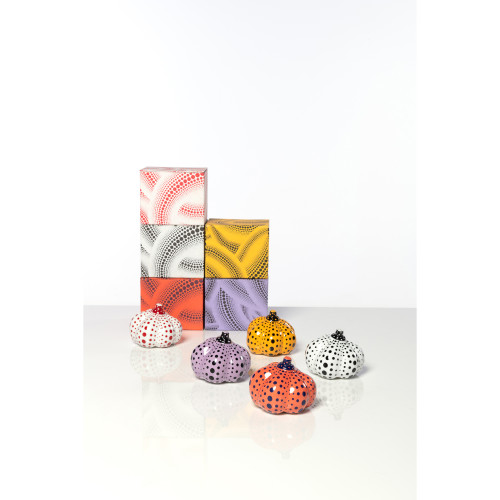
Yayoi Kusama (born 1929) Pumpkins, set N3, (set of 5)
Estimation : 35000 / 45000 €
Holder in 2014 of the record for the most expensive work by a living artist (7.1 million dollars), Yayoi Kusama has gradually risen to become a key figure on the Japanese scene. His work has been the subject of several major exhibitions such as at the MoMA in 1998, at the Tate Modern in 2012 and at the Centre Pompidou, which in 2011 organised his first retrospective in France.