


On the occasion of its next sale dedicated to modern and contemporary art on 6 December, PIASA will auction a selection of works by leading 20th and 21st century artists from major European private collections.
The New Realism will be represented by major works by Caesar and Arman, among others, while the Narrative Figuration will be distinguished by a significant set of paintings by Erro, Monory, Rancillac, Klasen, Schlosser, Telemachus and Adami, to name a few. The French abstract scene will also attract attention, with works by Geer van Velde, Bram van Velde and Olivier Debré. In addition, there are historical works by Daniel Buren and Jean Pierre Pincemin that will illustrate in a very significant way the current of radical abstraction. Also noteworthy is a spectacular painting by Roberto Matta in 1977 and a painting by Robert Combas dated 1986. Finally, international contemporary art will attract attention with a sculpture by Paul Mc Carthy and an exceptional painting by Damien Hirst.
JEAN FERRERO COLLECTION: THE NEW REALISM AND THE NICE SCHOOL
The session presents an important collection of works by artists from the New Realism and Nice School movement, from the collection of Jean Ferrero, a great witness to the artistic life of the Côte d'Azur in the second half of the 20th century. Caesar's famous series of "Compressions" was initiated in 1960 after he accidentally discovered a giant American hydraulic press in a scrap yard in Gennevilliers that could swallow up the size of a car. As shown by our Compression of bumpers (circa, 1960), the sculptor chose the elements according to their intrinsic properties: the shapes are intertwined with a marked desire for composition, in order to determine a parallelepipedic block in their stacking. The degree of compression of the shapes has been designed to enhance the reflective quality of the bumper metal. When Caesar presented his first "Compressions" at the 16th Salon de Mai in 1960, the public screamed in scandal. More knowledgeable, art critic Pierre Restany saw a decisive break in the history of sculpture, evoking "a new stage of metal", subjected to "a quintessential reduction". In this capacity, he invited César a few months later to join the group of New Realists he had formed in October 1960 with, among others, Yves Klein, Arman, Raymond Hains, Martial Raysse, Jean Tinguely, Niki de Saint Phalle. The art critic had perceived in these artists a common point in their work, a method of appropriation of reality that he assimilated to "urban, industrial and advertising recycling" and that he brought closer to Marcel Duchamp's ready made. However, Caesar kept the visual indifference of the ready-made at bay, since through the choice of materials, the mastery of the compression process, he reintroduced the notion of the creator and showed an attention to the sculptural properties of the work.
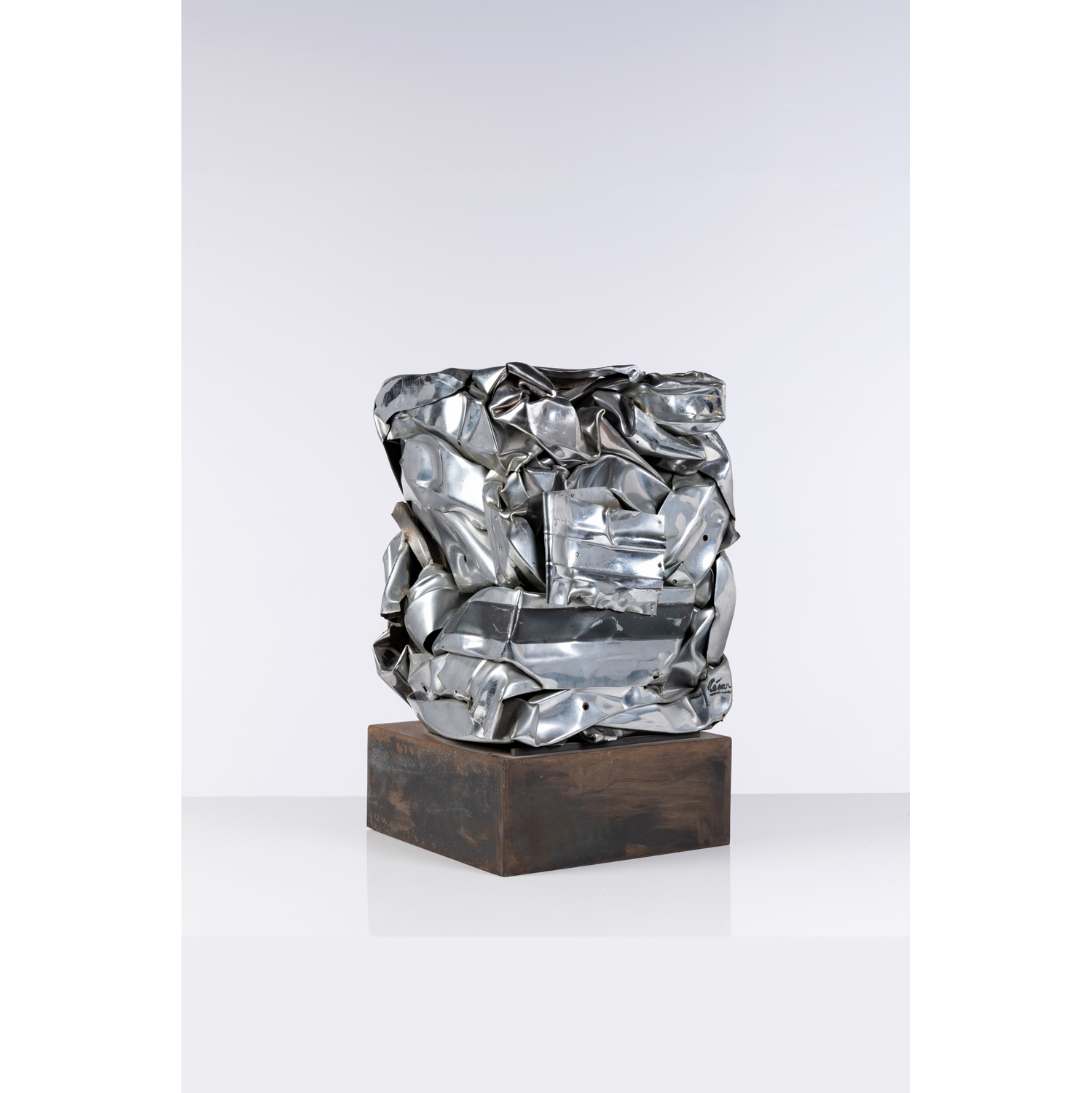
Lot 36 - Caesar (Caesar Baldaccini said) (1921-1998)
Bumper compression, circa 1960
Compressed metal
Signed lower right
55 x 40 x 41 x 41 cm
Unique piece
Estimate: 90 000 / 110 000 €
THE NARRATIVE FIGURATION, FROM AN IMPORTANT EUROPEAN PRIVATE COLLECTION
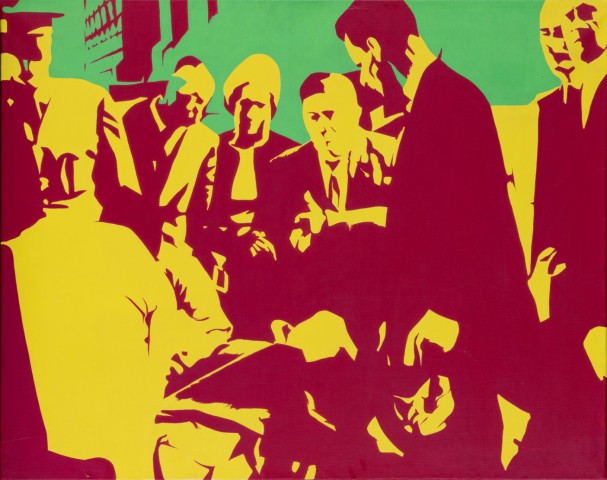
An important chapter of the sale is devoted to Narrative Figuration. Coming from the same European collection, these works, very well dated, form a remarkable ensemble. The current of narrative figuration appeared through two exhibitions organized by the art critic Gérald Gassiot-Talabot: "Mythologies quotidiennes", in 1964 at the Musée d'Art moderne de la Ville de Paris, and "La Figuration narrative dans l'art contemporain", in 1965, at the Creuze gallery.
Marking a renewal of figuration, the emergence of this movement is to be considered as a reaction to the lyrical abstraction and formalist coldness of American Pop art, to which they contrast "the need to reflect an increasingly complex and rich daily reality. " (Gérald Gassiot-Talabot). Coming from quite distinct backgrounds, the main protagonists of the movement are Valerio Adami, Gilles Aillaud, Eduardo Arroyo, Leonardo Cremonini, Erró, Gérard Fromanger, Peter Klasen, Jacques Monory, Bernard Rancillac, Antonio Recalcati, Peter Stämpfli and Hervé Télémaque. Beyond the diversity of their plastic language, they have in common the photographic transfer, the smooth and flat processing, the simplified drawings with sharp and precise outlines inspired by illustration, advertising and cinema techniques. If by all these characteristics, the artists of narrative figuration are not a priori at the opposite of those of American Pop art, they are nevertheless distinguished by the refusal of any ideological neutrality and by the introduction of the anecdote and time into painting. Thus, in 1967, Gérald Gassiot-Talabot defined, on the occasion of the exhibition "Comic Strip and Narrative Figuration" presented at the Decorative Arts: "Any plastic work that refers to a representation represented over time, through its writing and composition, without there always being strictly speaking a "narrative". Indeed, their works often integrate a temporal dimension into the composition games, montages and juxtapositions of scenes inspired, for Monory from cinéma, or for Erró and Rancillac by comics. As Telemachus says, there is a certain "urgency of expression" that manifests itself through the search for a strong visual impact in the treatment of forms.
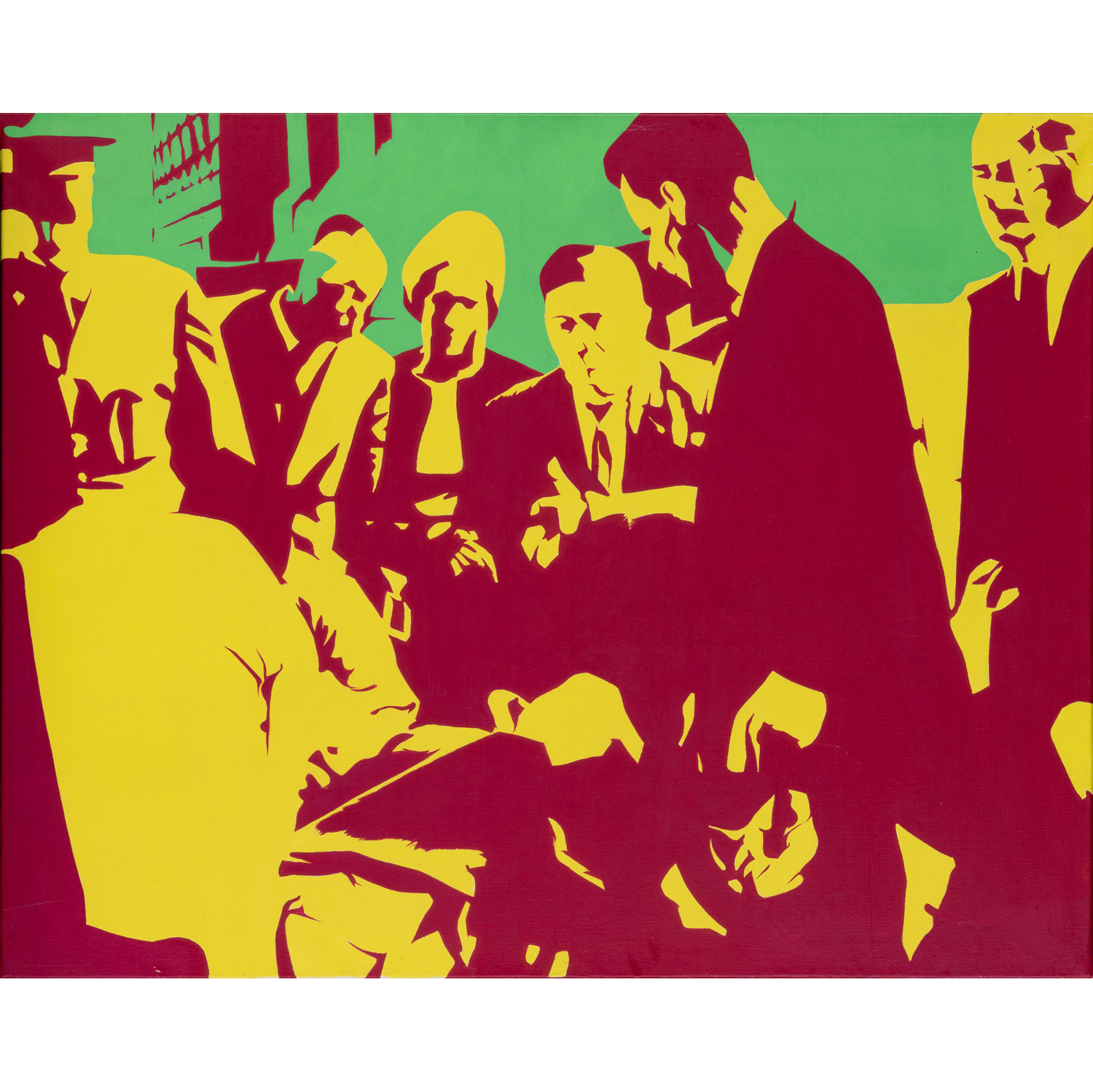
Lot 53 - Bernard Rancillac (born 1931)
Fin tragique d’un apôtre de l’Apartheid, 1966
Acrylic on canvas
Signed dated and titled on the back
73 x 92 cm
Estimate: 40 000 / 60 000 €
FRENCH RADICAL ABSTRACTION
The radical French movement is represented with historical pieces, including a White Acrylic Painting on White and Blue Striped Fabric (1969) by Daniel Buren, as well as free canvases by Pincemin and André Valensi, each of which was previously held in private French collections. Daniel Buren appeared at the forefront of the artistic scene through the public and often spectacular demonstrations organized between January and September 1967 by the BMPT group (an acronym consisting of the names of Buren, Mosset, Parmentier, Toroni). Motivated by the same critical reflection on painting, BMPT artists have developed an elementary formal vocabulary (vertical stripes, horizontal stripes, black circles, brushstrokes) whose execution is a mechanical and repetitive gesture. Their choice of a minimum intervention and perfect neutrality stems from a desire to break with the illusion of art, to demystify painting in order to better assert its pure and simple presence. Thus, the striped fabric strips that Buren began using around 1965 became from 1967 onwards the "visual tool" (Buren) from which he legitimized his entire conception of painting. As shown in White Acrylic Painting on White and Blue Striped Fabric (1969), the subject shown corresponds to the only technique used: it consists of vertical white and blue stripes, 8.7 cm wide, the two extreme white stripes being covered with white paint on the front and back. Through this "reduction of the painted fact" (Buren), the artist questions and develops the notion of painting to the very limits of its functioning. Depriving painting of all emotional charge, Buren reveals nothing more than his material reality.
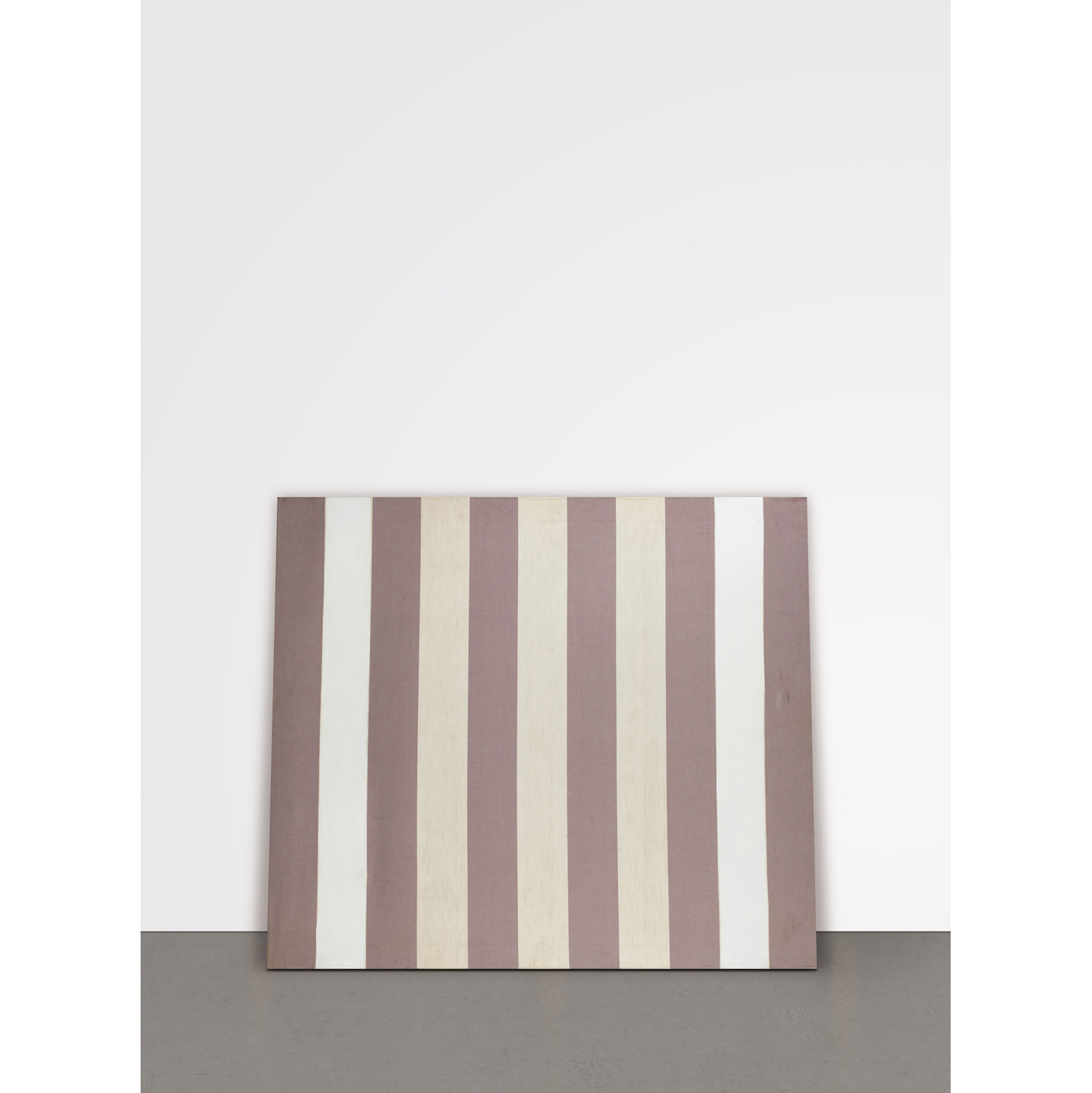
Photo-souvenir : Peinture acrylique sur tissu rayé blanc et bleu, décembre 1969, 85,2 x 100,5 cm. © Daniel Buren/Adagp, Paris. Détail
Lot 26 - Daniel Buren (born in 1938)
White acrylic paint on white and blue striped fabric, December 1969
White acrylic paint on woven cotton canvas with white and blue stripes, alternating and vertical, each 8.7 cm wide
85.2 × 100.5 cm
A Warning (certificate) will be written by Daniel Buren on behalf of the new purchaser
ROBERTO MATTA, THE LAST OF THE SURREALISTS
PIASA presents a spectacular painting by Roberto Matta from 1977, a Chilean artist known for his unique style that lies between surrealism and abstraction. Roberto Matta arrived in Paris at the age of 22 and very quickly met the great figures of the avant-garde: he met Le Corbusier, Picasso, Miro, Dali, then joined André Breton's surrealist movement. He then had the honour of participating in the 1938 International Exhibition of Surrealism, where he made the decisive acquaintance of Marcel Duchamp. After spending the war years in the USA, Matta will continue to work between Rome, Paris and London. Moving closer to the Italian Communist Party, he devoted his vast compositions of the 1950s and 1960s to the political issues of his time, which would engage him in all revolutionary struggles. When her painting does not directly confront the social and historical reality of her time, it is timeless and very convincing because of its strong metaphorical power. Thus, Rooming life (1977), whose imposing format is worthy of historical painting, presents a composition in movement, where vaguely anthropomorphic sign objects coexist with mechanical elements in a spirit close to Marcel Duchamp's Grand Verre. The latter, whom Matta had met in New York in 1938, left a lasting impression on his entire work. The work seems to be subjected to a rotating force in a unified and floating space, whose depth is given by their perspective, by the interplay of colour variations, the alternating areas of opacity and transparency. Through these enigmatic spaces, Matta offers the viewer other forms of knowledge of the world, inaccessible to our perceptual capacities, and which appear to be in constant mutation. As Édouard Glissant pointed out, they are, as "prefigurations of sidereal spaces, visions of this world to which humanity will conform its sensitivity when it has explored it in the imagination or reality, all possible dimensions" (Édouard Glissant, Le troisième œil, preface written for the catalogue of the exhibition "Matta", Centre culturel d'Issoire, 1987).
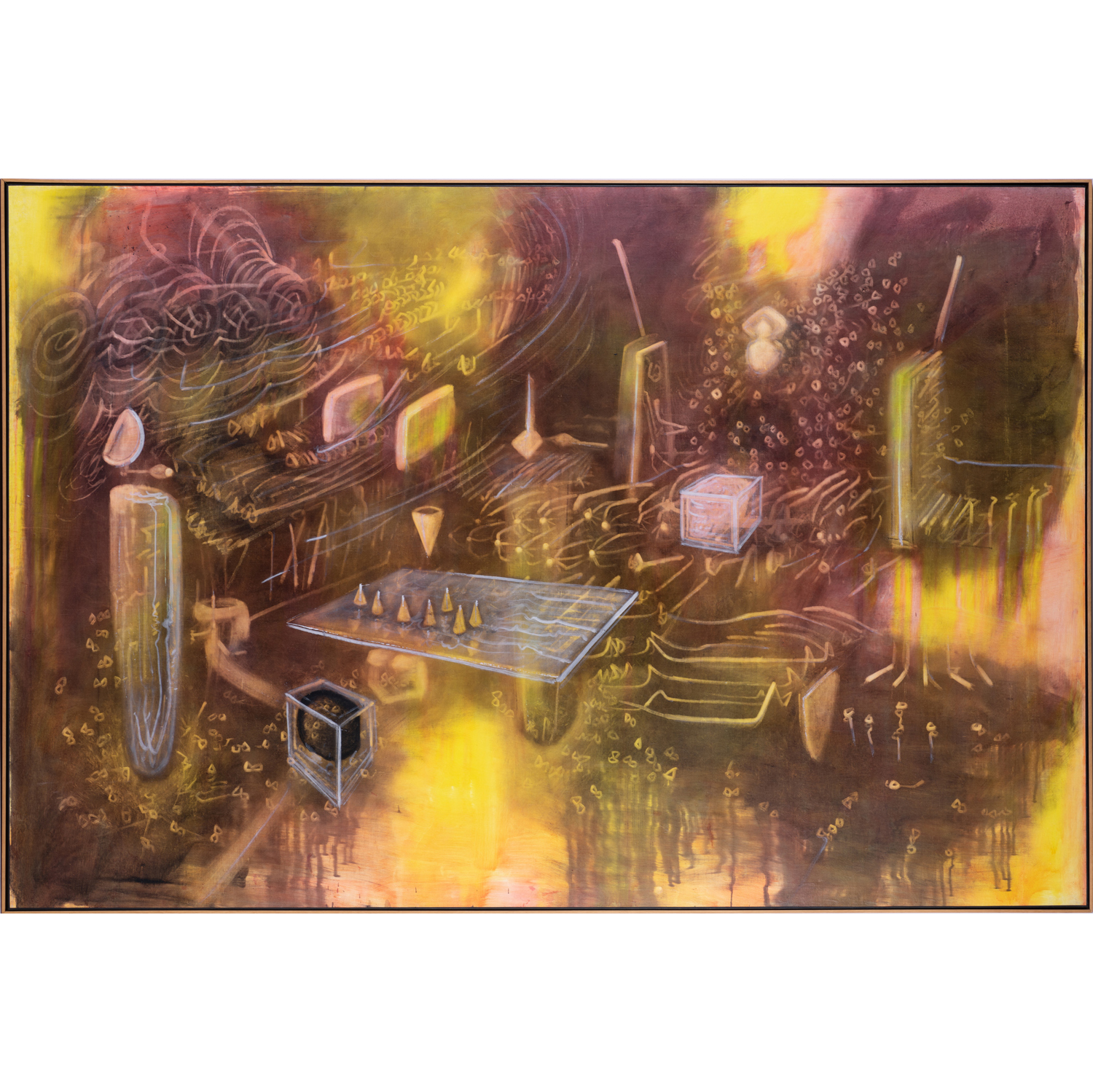
Lot 17 - Roberto Matta (1911-2002)
Rooming life, 1977
Oil on canvas Signed three times, dated, titled and located on the back
198 x 296 cm
Estimate: 120 000 - 180 000 €
DAMIEN HIRST, THE MOST FAMOUS OF THE "YOUNG BRITISH ARTISTS"
Damien Hirst, who was revealed to the general public by the advertiser and collector Charles Saatchi in the 1990s, is no longer presented. His fascination with death, which dates back to the years when he worked in a morgue to finance his studies, is expressed in his work through the major place he gives to the themes of Memento mori and Vanitas vanitatum. Hirst dialogues with death in a tone that oscillates between humour, sulphurous, outrageous and irreverent, such as the famous cow cuts kept in large windows filled with formalin (the first ones dating from the 1990s), or For the Love of God (2008), a platinum copy of an 18th century human skull covered with 8,601 diamonds, sold for $100 million.
Hirst explored the rhetoric of the Memento mori through the series of "Beautiful mars cathexis painting", in which the motif of the skull appears at the centre of a real chromatic explosion. The artist uses spin painting, a pictorial process that uses centrifugal force to distribute the paint on its support. By using this technique, he gives a performative dimension to the work, since the distribution of colours is randomly delivered (should this be seen as a nod to Pollock's dripping?). He also appreciates this process for its neutral character, where any expression of the artist's subjectivity is banned. Damien Hirst had a great pleasure in sharing the execution of his spin paintings with friends and family, from David Bowie to children in schools: "I like to do spin paintings with children. I have a spin machine that I brought to my children's school so that everyone can enjoy it. The pleasure they have in participating in the creation of a work of art values them, while the fact of participating in the elaboration of a painting whose final result they ignore is very surprising. They immortalize a feeling, they feel a palette of emotions, a fleeting and colorful happiness that leaves like traces in time, like footprints in the snow." (Damien Hirst) With Beautiful Apocatequil narcissism painting (2012), Hirst skillfully explores the technique of spin painting: he plays on the contrast between the unbridled explosion of painting and the morbid, even threatening, character of the skull. While having the value of an exorcism, this realization reminds us, against a colourful and joyful background, that death lurks behind all beauty.
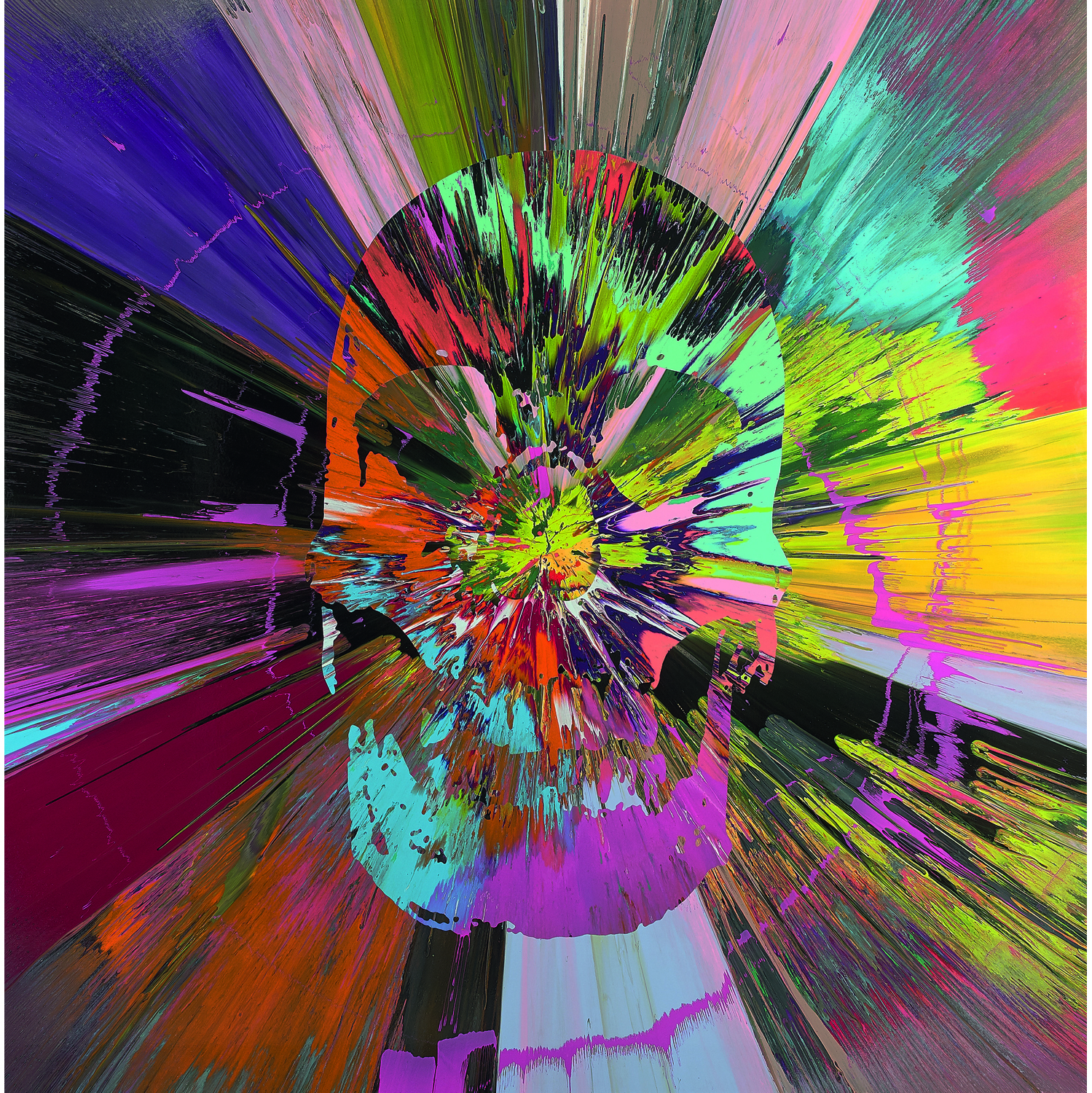
Lot 85 - Damien Hirst (born in 1965)
Beautiful Apocatequil narcissism painting, 2012
Mixed media on canvas
Signed twice, stamped with the artist's stamp, dated and titled on the back
Unique piece
213 x 213 cm
Estimate: 500 000 - 700 000 €
