As part of the "Art + Design of a European Private Collection" session on Wednesday, September 23, 2020, PIASA presents a coherent collection of furniture and works of art by artists from the second half of the 20th century, including Daniel Buren.
The artist began his training in the workshop of "general painting and decoration" of the School of Fine Arts from 1957 to 1960 and then extended it at the School of Fine Arts from where he will be dismissed for absenteeism. On the occasion of an order for decorative mosaics in a hotel in St. Croix in the Caribbean, Buren used for the first time a canvas woven of white and colored vertical stripes.
This motif will be used as a background for works with biomorphic motifs that he will execute between 1965 and 1966 and then become from 1967 "the visual tool" (Buren) from which he will legitimize his entire conception of painting. Buren will limit his manual intervention to the application of white paint on the two white stripes located at the ends of his canvases, themselves freed from their frames and frames.
This renunciation of the pictorial gesture, bringing painting back to its zero degree, will be accompanied by public demonstrations organized between January and September 1967 by the group B. M. P. T. formed by Buren and the painters Olivier Mosset, Michel Parmentier and Niele Toroni. Motivated by the same critical reflection on painting but also on the art world and its system, the artists of B. M. P. T. developed an elementary formal vocabulary (vertical stripes, horizontal stripes, black circles, brush marks) whose execution is based on a mechanical and repetitive gesture.
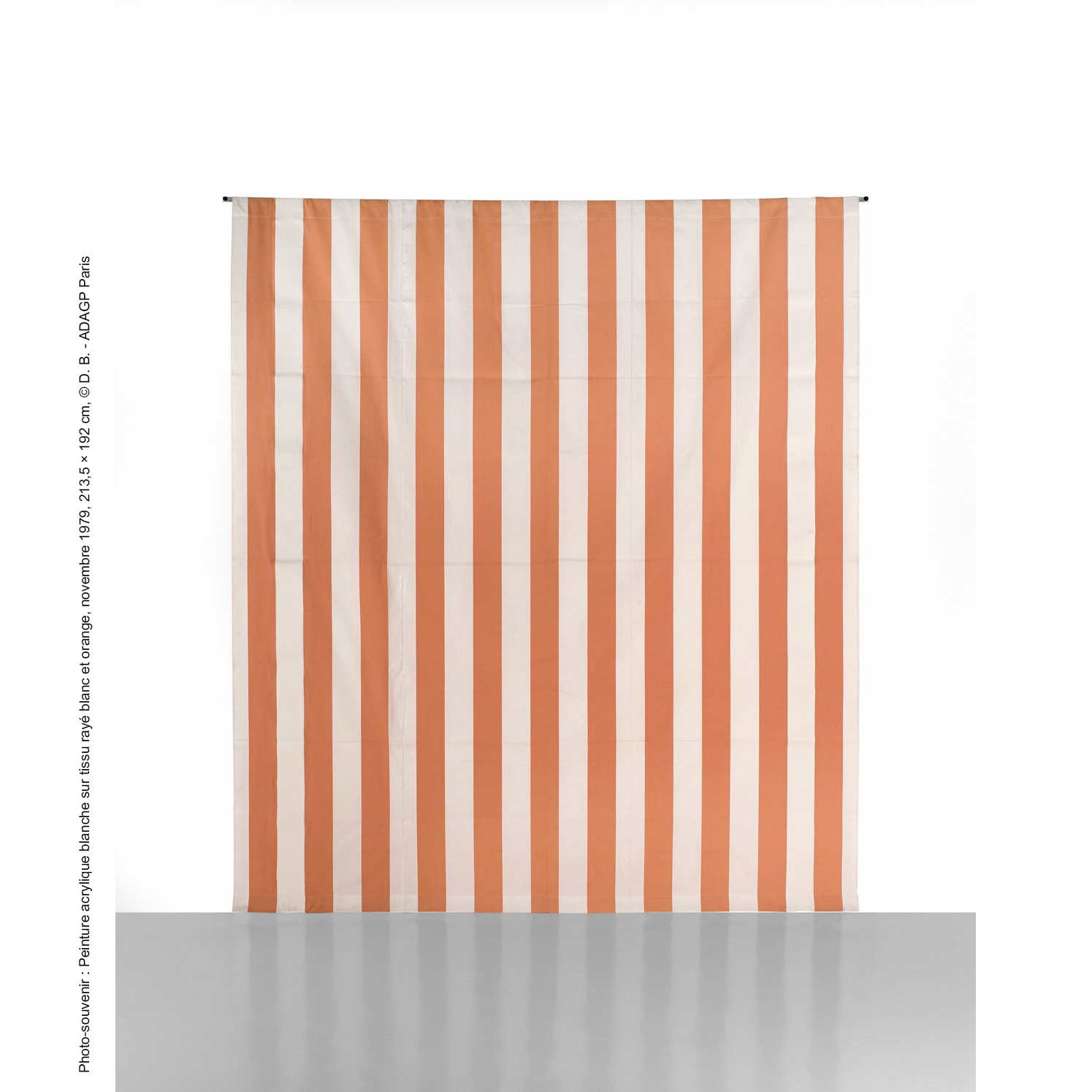
Daniel Buren (born 1938)
White acrylic paint on white and orange striped fabric, November 1979
ESTIMATE UPON REQUEST
Their choice of minimal intervention and perfect neutrality stems from a desire to break with the illusion of art, to demystify painting in order to better assert its pure and simple presence. The series of Manifestations organized by B. M. P. T. are to be understood as a methodical destabilization of the system. Thus, during Manifestation 3 organized in June 1967 at the Musée des Arts Décoratifs in Paris, the public was installed in front of 4 canvases of an impersonal style created by each of the members. After 45 minutes of waiting, the spectators received a leaflet informing them that they had only been invited to look at the painting.
The group disbanded after five joint demonstrations that had taken place in 9 months because Parmentier refused the principle of having each person paint a canvas in the style of the other three. These Manifestations led Buren to define a new status for painting: "Painting should no longer be the vision/illusion, even mental, of a phenomenon (nature, subconscious, geometry...), but VISUALITY of painting itself" (1969).
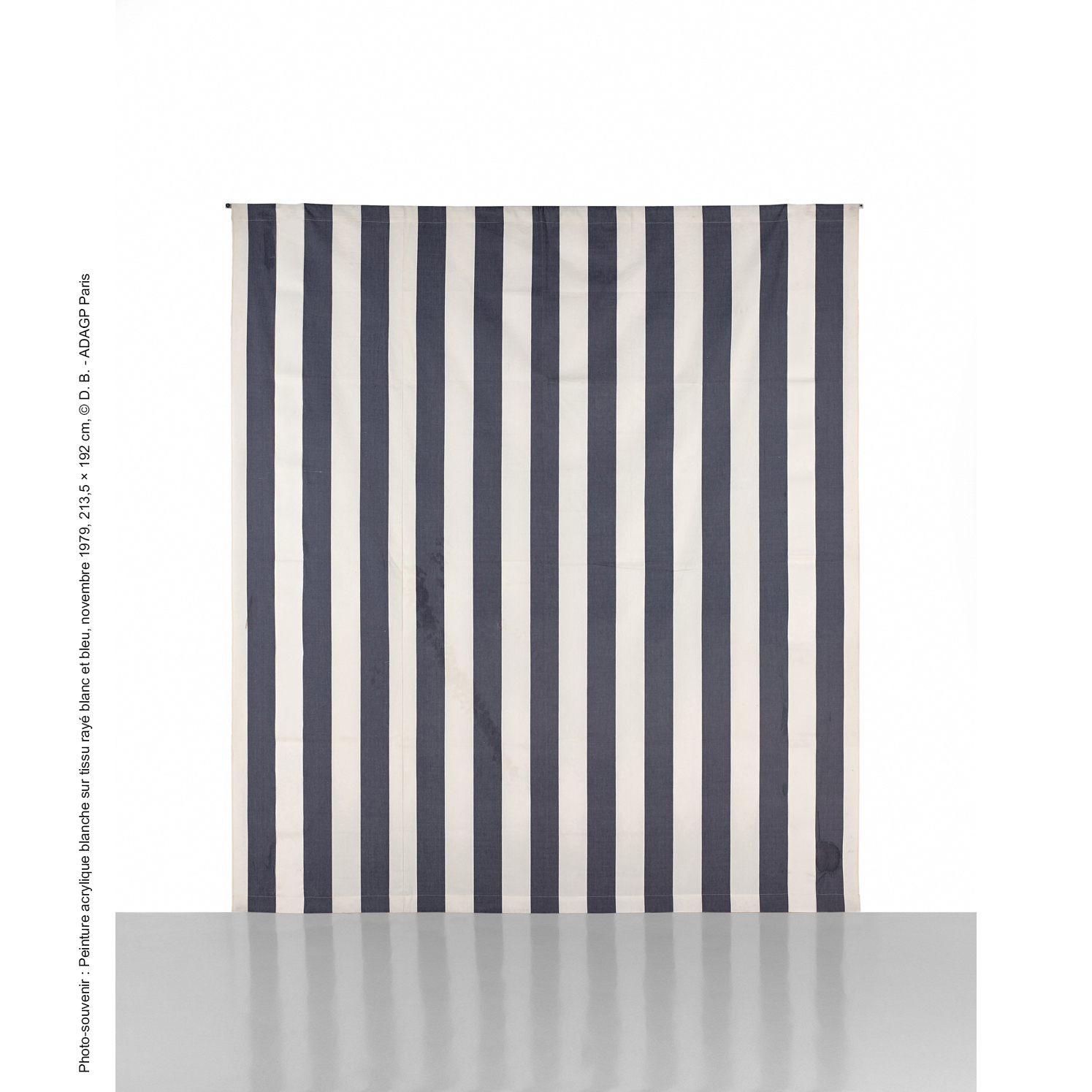
The two works we present, White acrylic painting on white and orange striped fabric, (November 1979) and White acrylic painting on white and blue striped fabric (November 1979), show that the subject shown corresponds to the technique used: it is made up of vertical white and blue, or white and orange stripes 8.7 cm wide, the two extreme white stripes being covered with white paint, on the front and back. By this "reduction of the painted fact" (Buren), the artist questions and develops the notion of painting to the very limits of its functioning. Depriving painting of any emotional charge, he reveals nothing other than its material reality.